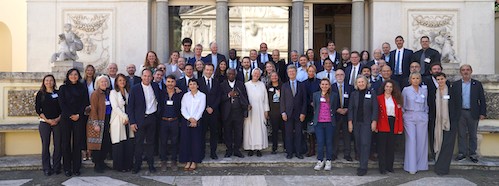
On October 16-17, 2025, approximately fifty experts gathered at the Casina Pio IV in Vatican City for the seminar, Digital Rerum Novarum: Artificial Intelligence for Peace, Social Justice, and Integral Human Development, convened by the Pontifical Academy of Social Sciences, and cosponsored by the Law School of the University of Notre Dame.
The wide-ranging discussion contained diverse perspectives on key questions regarding the social and ethical implications of artificial intelligence, many of which are captured in the report of the seminar’s proceedings.
In consideration of the information and views presented at the seminar, the following important conclusions can be drawn from the proceedings:
Artificial intelligence introduces a new stage of technological development that no longer merely reconfigures economies and production systems but also calls into question the meaning and value of the human person as a subject. It presents both unprecedented promises and serious risks for human coexistence. The challenge is not only technical; it is also spiritual and political.
According to the social teaching of the Catholic Church, technical progress must always be subordinated to the dignity of the person and the common good, avoiding the “technocratic paradigm” that absolutizes efficiency and degrades fraternity and political responsibility. As affirmed in Fratelli tutti,[1] a vision of social friendship and universal fraternity requires that AI be developed, deployed, and governed to serve peace, advance integral human development, and strengthen cooperation, rather than lead to destructive competition and social fragmentation.
In the wise words of the Holy Father: “AI is above all a tool. By definition, tools point to the human intelligence that created them and draw much of their ethical strength from the intentions of the individuals who wield them. In some cases, AI has been used in positive and indeed noble ways to promote greater equality, but there is also the
...
Read all
On October 16-17, 2025, approximately fifty experts gathered at the Casina Pio IV in Vatican City for the seminar, Digital Rerum Novarum: Artificial Intelligence for Peace, Social Justice, and Integral Human Development, convened by the Pontifical Academy of Social Sciences, and cosponsored by the Law School of the University of Notre Dame.
The wide-ranging discussion contained diverse perspectives on key questions regarding the social and ethical implications of artificial intelligence, many of which are captured in the report of the seminar’s proceedings.
In consideration of the information and views presented at the seminar, the following important conclusions can be drawn from the proceedings:
Artificial intelligence introduces a new stage of technological development that no longer merely reconfigures economies and production systems but also calls into question the meaning and value of the human person as a subject. It presents both unprecedented promises and serious risks for human coexistence. The challenge is not only technical; it is also spiritual and political.
According to the social teaching of the Catholic Church, technical progress must always be subordinated to the dignity of the person and the common good, avoiding the “technocratic paradigm” that absolutizes efficiency and degrades fraternity and political responsibility. As affirmed in Fratelli tutti,[1] a vision of social friendship and universal fraternity requires that AI be developed, deployed, and governed to serve peace, advance integral human development, and strengthen cooperation, rather than lead to destructive competition and social fragmentation.
In the wise words of the Holy Father: “AI is above all a tool. By definition, tools point to the human intelligence that created them and draw much of their ethical strength from the intentions of the individuals who wield them. In some cases, AI has been used in positive and indeed noble ways to promote greater equality, but there is also the possibility of its misuse for selfish gain at the expense of others, or worse still, to foster conflict and aggression.”[2]
These words remind us that the problem is not the intelligence of machines but the wisdom of those who create and use them. The question is not what AI can do, but what we should do, to ensure that technological development is oriented toward the flourishing of the whole person and of all persons.
The magnitude of the transformations brought about by artificial intelligence demands not only prudent judgment about its immediate applications but also the articulation of a set of principles to guide the actions of public authorities, businesses, communities, and the individuals most responsible for advancing these technologies. These principles do not emerge from theoretical abstraction but from the living tradition of the Church’s social teaching, from dialogue with the scientific community, and from the empirical observation of the risks and opportunities that AI presents for peace, justice, and integral human development. As Pope Leo said: “The epochal change we are now undergoing makes even more necessary a constant interaction between the faithful and the Church’s Magisterium, between ordinary citizens and experts, between individuals and institutions. Here too, it needs to be acknowledged once more that reality is best viewed from the sidelines, and that the poor are possessed of unique insights indispensable to the Church and to humanity as a whole.”[3]
What follows is not intended as an exhaustive catalog of norms, but as a guiding framework that allows us to discern, judge, and direct technological progress so that the advance of technique never becomes detached from the horizon of human dignity and the common good.
Final Statement on Artificial Intelligence, Peace, Social Justice and Integral Human Development
Artificial intelligence (AI) is ushering in a new era of technological globalization that is reshaping not only economies and production systems, but also emotions, beliefs, and social bonds on a planetary scale. Profound transformations in work, governance, and security are accelerating, with unprecedented promises but also serious risks to human coexistence.
AI is developing within an ambivalent landscape, fraught with both promise and dilemmas. While it opens unprecedented opportunities for education, health, and employment, it also reveals risks that can exacerbate inequalities, undermine social peace, and concentrate power in the hands of a few. AI can contribute to remarkable progress in areas as diverse as personalized healthcare, quality education, effective public administration, and infrastructure management. However, it is also true that there are risks that must be addressed with particular caution: the concentration of power in a few platforms, the erosion of public debate, the deepening of inequalities, the accelerated depletion of natural resources, the polarization of labor income, the violation of personal privacy, and the manipulation of human consciousness.
According to the Social Teaching of the Church, technological progress must always be subordinated to the dignity of the person and the common good, avoiding the technocratic paradigm that absolutizes efficiency and degrades fraternity and political responsibility. As emphasized in Fratelli tutti,[4] a vision of social friendship and universal fraternity demands that AI be used to serve peace, reduce inequalities, and strengthen cooperation, not destructive competition or social fragmentation.
It is therefore urgent to integrate ethics into the design process and promote integral human development also through design, by means of incentives that align AI's contributions with the flourishing of the individual and the community. In this endeavor, faith offers the horizon of the "why," while ethics and law provide the "how," the concrete instruments to guarantee justice. Only the articulation of both can sustain true technological development and governance at the service of human dignity.
The centrality of peace in Catholic social teaching (CST) is robust, with the concept of peace appearing 334 times across the main documents of CST, beginning notably with Rerum Novarum in 1891. The concept of social justice was formally introduced in Quadragesimo Anno in 1931, followed by the concept of integral human development in the encyclical Populorum Progressio by Pope Paul VI in 1967.
Peace can be identified as the central tenet in the evolution of CST. A core principle underlying the CST understanding of peace is the adherence to the natural order, defined as living in accordance with human nature. This principle grants significant space for freedom, specifically freedom for genuine good, which is deemed more crucial than freedom from constraint. Since humanity shares a singular natural order, living in this manner fosters peaceful relationships not only among humans but also aids in constructing genuine universal good.
AI possesses the capability to enhance humanity’s comprehension of its own nature and the order of nature within creation. A recurring mandate from the Church leadership dictates that technology must serve humanity, not supersede it. Pope Leo has advocated for AI to function as a tool for human progress rather than an apparatus designed for human replacement. Pope Francis offered a cautionary note regarding the emergence of a world abundant in technology but impoverished in humanity. It is imperative that humanity remains the focal point of all technological advancement, recognizing that the trajectory and ultimate form of AI are ultimately subject to human choice and design.
The ethical and normative questions surrounding AI are subordinate to the foundational anthropological question: What does it mean to be human? Referring to the 1948 advent of the Universal Declaration of Human Rights (UDHR), placing the human person at the core of technological inquiry proposes a perspective anchored in moral realism. This approach seeks to engage in a necessary dialogue regarding AI, acknowledging the dual reality that, while certain limitations are essential, AI retains significant potential for human benefit, moving past simplistic narratives of either doom or utopian celebration.
It is therefore necessary to implement AI with ethics by design and integral human development by design, complemented by creating incentives that align AI’s contributions with human betterment.
[1] Encyclical Letter Fratelli Tutti of the Holy Father Pope Francis on fraternity and social friendship, October 3 (https://www.vatican.va/content/francesco/en/encyclicals/documents/papa-francesco_20201003_enciclica-fratelli-tutti.html)
[2] Message from Pope Leo XIV to the participants of the Second Annual Conference on Artificial Intelligence, Ethics, and Corporate Governance, June 20, 2025 (https://www.vatican.va/content/leo-xiv/en/messages/pont-messages/2025/documents/20250617-messaggio-ia.html)
[3] Apostolic exhortation Dilexi Te of the Holy Father Leo XIV to all Christians on love for the poor, October 4, 2025 (https://www.vatican.va/content/leo-xiv/en/apost_exhortations/documents/20251004-dilexi-te.html)
[4] Encyclical Letter Fratelli Tutti of the Holy Father Pope Francis on fraternity and social friendship, October 3, 2020 (https://www.vatican.va/content/francesco/en/encyclicals/documents/papa-francesco_20201003_enciclica-fratelli-tutti.html)
Read Less