
Let us meet, let us talk, let us negotiate! War is never inevitable.
Pope Leo XIV, Magnifica Humanitas, no. 222
The Workshop
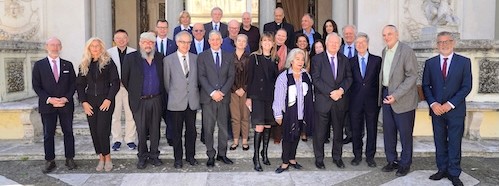
On 19 and 20 October 2026 the Pontifical Academy of Social Sciences convened a workshop “Pathways to Peace: Religion, Peace, and Conflict.” It was the second and concluding meeting of the Academy’s “Pathways to Peace” series, which rests on Saint Thomas Aquinas’s account of the social virtues as complementary pathways to peace: virtues that shape the moral life of each person and find expression in institutions that, in turn, sustain them. Twenty-five scholars and practitioners from many traditions and disciplines discussed the scriptural and theological foundations of peace, the historical dimensions of religious motivations for war, the trajectories of empire and secularity, up to, and including the present crises in the Middle East, Ukraine, Myanmar and the Amazon, and finally the practical question of how religious actors can help to resolve conflict.
The meeting took place at a grave moment when around the world multiple wars continue unabated (“World War III fought piecemeal” in the words of Pope Francis). Steps toward disarmament are declining and the language of “holy war” has returned to the mouths of senior clerics and public officials in several countries. In Pope Leo XIV’s words, “war is back in vogue and a zeal for war is spreading.” The concept note framed the question starkly: “If faith can be a wellspring of peace, it is also vulnerable to weaponization.” The workshop asked how religion is weaponized, how it can be reclaimed, and what the Church’s social teaching requires of believers and institutions today.
Church Teaching
The workshop treated Catholic social teaching as the framework within which a multi-faith conversation could take place. Speakers drew on Saint Augustine’s understanding of peace as the tranquility of order and on his teaching of the two cities, which provides a realistic account of human life after
... Read allLet us meet, let us talk, let us negotiate! War is never inevitable.
Pope Leo XIV, Magnifica Humanitas, no. 222
The Workshop
On 19 and 20 October 2026 the Pontifical Academy of Social Sciences convened a workshop “Pathways to Peace: Religion, Peace, and Conflict.” It was the second and concluding meeting of the Academy’s “Pathways to Peace” series, which rests on Saint Thomas Aquinas’s account of the social virtues as complementary pathways to peace: virtues that shape the moral life of each person and find expression in institutions that, in turn, sustain them. Twenty-five scholars and practitioners from many traditions and disciplines discussed the scriptural and theological foundations of peace, the historical dimensions of religious motivations for war, the trajectories of empire and secularity, up to, and including the present crises in the Middle East, Ukraine, Myanmar and the Amazon, and finally the practical question of how religious actors can help to resolve conflict.
The meeting took place at a grave moment when around the world multiple wars continue unabated (“World War III fought piecemeal” in the words of Pope Francis). Steps toward disarmament are declining and the language of “holy war” has returned to the mouths of senior clerics and public officials in several countries. In Pope Leo XIV’s words, “war is back in vogue and a zeal for war is spreading.” The concept note framed the question starkly: “If faith can be a wellspring of peace, it is also vulnerable to weaponization.” The workshop asked how religion is weaponized, how it can be reclaimed, and what the Church’s social teaching requires of believers and institutions today.
Church Teaching
The workshop treated Catholic social teaching as the framework within which a multi-faith conversation could take place. Speakers drew on Saint Augustine’s understanding of peace as the tranquility of order and on his teaching of the two cities, which provides a realistic account of human life after the Fall: the earthly city is marked by pride and the will to dominate, yet it is not condemned to endless violence because it remains oriented toward the City of God. St. Thomas Aquinas emphasized barriers to theocratic overreach, inter alia in his teachings about the sanctity of individual conscience (which binds even when it errs), and, on the other hand, maintains that limits should be placed on the authority of civic authorities to dictate matters of faith and to punish moral failings (“let the wheat and the tares grow together until the harvest”). Likewise, his teaching on the transcendence of faith implies a recognition that no one carries the whole truth “in his pocket.”
Other important sources for the group’s reflections included the Second Vatican Council’s declaration Nostra Aetate, which affirmed that the Church “rejects nothing that is true and holy” in other religions and rejected every form of antisemitism; Saint John Paul II’s World Day of Prayer for Peace at Assisi in 1986, where he “prayed side by side” with representatives from the world’s other religions, “not in some impossible fusion, but, at last, not against one another;” as well as Pope Francis’s Document on Human Fraternity and the Encyclical Fratelli Tutti.
The Teaching of Pope Leo XIV
Peace has been at the center of Pope Leo XIV’s pontificate since his first words, “Peace be with you all,” when he described the peace of the risen Christ as “an unarmed peace and a disarming peace.” In his Message for the World Day of Peace of 1 January 2026, he criticized nuclear deterrence as an order “built not on law, justice and trust, but on fear and domination by force,” warned that “decisions about life and death are increasingly ‘delegated’ to machines,” and asked religious communities to refuse “to drag the language of faith into political battles to bless nationalism.” In his Address to the Diplomatic Corps of 9 January 2026, he lamented that “a diplomacy that promotes dialogue and seeks consensus among all parties is being replaced by a diplomacy based on force,” affirmed that human dignity “always counts for more than any mere national interest,” and warned that language “is becoming more and more a weapon with which to deceive, or to strike and offend opponents.”
His first encyclical, Magnifica Humanitas (dated 15 May 2026) gave the workshop its specific framework. It declares that “peace begins with each one of us” and sets out five paths to peace: to disarm words, to build peace through justice, to adopt the perspective of the victims, to cultivate a healthy realism, and to revive dialogue. “Let us disarm words and we will help to disarm the world.” It declares that “those who use the name of God to foment divisions, legitimize terrorism, violence or war betray his true nature, for to fight in the name of religion means attacking religion itself.” Pope Leo recognized, nonetheless, how all religious traditions have sometimes failed in this regard. Echoing the words of Pope John Paul II, Leo invites members of his own church “to examine honestly the times when acquiescence was given to ‘intolerance and even the use of violence in the service of truth’.” More broadly, Pope Leo cautions against an “attitude of resignation to the inevitability of war,” whereby dialogue and peace come to be viewed as “irrational positions that ignore the risks at stake.” From this attitude, a culture can emerge that “normalizes and justifies war” with result that a “mentality of armed equilibrium and deterrence” take precedence over concrete measures to build peace. People of faith from all traditions have a responsibility to reject this “mindset of violence.” To this end “interreligious dialogue plays a decisive role, because at the heart of the great spiritual paths lies a message of peace.”
What We Learned in the Workshop
The historical sessions examined the claim that secularity is a pathway to peace. It was recalled that the secular state emerged from the wars of religion, yet proved unable to prevent the far bloodier wars of nations that followed; one participant observed that humanity killed in the name of God, then of science, nations and races, and now again of God. Another argued that secularization is better understood as a long learning process in which the contents of the Axial Age traditions migrated into philosophy. The same participant warned that technology is becoming a new axis of bloc rivalry, between the U.S.-led Pax Silica and the China-based World Artificial Intelligence Cooperation Organization. Another participant explained how Charles [later Cardinal] Journet, writing in 1939, faced honestly the papacy’s past instigation of crusades and inquisition. With reference to the latter, he concluded that Christians should influence the temporal order by way of inspiration, not by imposing the truths of faith through civil law. Others showed that imperial violence proceeded through serial truces and an elastic claim of self-defense, patterns visible today in Ukraine, Gaza and the “forever wars” of the Middle East. Participants also drew from Mencius the principle that “humane duty overrides sovereignty” and that only a “concrete patriotism,” the love of each person rather than of an abstract nation, is defensible. It was noted that religion was seldom the real cause of the Northern Ireland conflict, and that separate schooling remains a real obstacle to understanding between its communities.
On sacred texts, one participant, drawing on long experience of interfaith conferences that “always conclude very happily,” called for a frank study of the passages each tradition uses to justify violence. Another speaker examined the Book of Joshua, whose commands of total destruction have served as a charter for colonial conquest and are invoked today in the West Bank, in Gaza and in U.S. diplomacy. It was shown that the fundamentalist reading rests on three beliefs: that the text was dictated by God, that it is literal history, and that its commands apply to living peoples. In contrast, the Catholic Church and the rabbinic tradition, by distinct but related paths, have made the commands of conquest inapplicable to any living peoples, the Church through its contextual and holistic reading of Scripture and the rabbis through their rulings on the commands of conquest. It was also observed that religious nationalists in Judaism, Christianity and Islam share the same theological structure, and dialogue partners were urged to know the “backyards” behind the moderates at the table. Another participant located in transcendence the humility and the obligations to the stranger that a purely secular ethics cannot supply.
On the present conflicts, speakers distinguished rabbinic Judaism, developed over two millennia, and a new creed of National Judaism, grown in the spirit of Zionism in the 20th century. One speaker spoke of the region’s war as “the first religious fundamentalist world war,” while another recovered a history of porous communities and coexistence in the Levant. The war in Ukraine was called “a wound on the body of Europe” in which the human person has been excluded from the values proclaimed, and a participant described a dialogue between senior German and Russian figures below the level of governments, aimed at disarming language and de-escalation where official diplomacy has collapsed. It was explained why many Buddhist monks in Myanmar have supported military rule, through patronage and an “ideology of order,” and why international Buddhist peace conferences have not yet addressed it. Others showed how climate crisis, criminal violence, electoral politics and religious intolerance converge in the Amazon. Among the resources for peace, it was found that seventeen religions converge in their cosmology and anthropology, and one speaker contrasted the tradition for which “in the beginning there is war” with the tradition, running through Saint Augustine, Saint Thomas Aquinas and the Church’s social teaching, for which in the beginning there is the logos and therefore dialogue. Finally, a speaker located the Christian contribution in Christ’s words “My kingdom is not of this world” and “Give to Caesar what belongs to Caesar, and to God what belongs to God,” and called for a renewed witness so that charity may again inform the earthly city. In Eastern Orthodoxy, the section on war and violence in the document, For the Life of the World: Towards a Social Ethos of the Orthodox Church (coordinated by the Ecumenical Patriarchate of Constantinople and published in 2020) runs parallel to the current theological and ethical pursuits of new war and peace frameworks in Catholic thinking and similarly aims to achieve a re-conception of justice and peace-making.
The following views were widely expressed, though perhaps not by every participant:
First, every religious tradition carries both deep resources for peace and passages and histories that can be bent in the service of violence. The question is not whether a tradition is peaceful in essence, but how it is read, taught and governed. Following Saint Thomas Aquinas, evil is parasitic on the good: religion can be distorted and instrumentalized precisely because it is a good and for the same reason it can be released from manipulation.
Second, religion is more often enlisted in war than it is the original cause of war. For instance, Russia’s sacralization of its conflict with Ukraine followed rather than preceded its military offensives, and this has deepened the longer the war has lasted. The Spanish Civil War of 1936-39 followed a similar trajectory. Third, the most dangerous religious movements of the present share a literal reading of sacred texts that are treated as commands still in force, the identification of living peoples with ancient enemies, de-humanization of the “Religious Other,” a claim to represent divine intentions, messianic urgency, and contempt for international law and secular institutions.
Fourth, many traditions have developed safeguards against these readings: the Catholic Church’s teaching on the interpretation of Scripture in Dei Verbum and Verbum Domini, the rabbinic restraints on the commands of conquest, the Qur’anic teaching that the diversity of communities is willed by God, and the Confucian subordination of the state to humane government provide salutary examples. These safeguards deserve to be taught, defended and invoked publicly. It was noted how believers too often “hide behind the beautiful texts” and lack the courage to address the poisonous ones.
Fifth, peace must be built through institutions as well as virtue. In the present era, these include institutions such as the United Nations to strengthen the rule of law, domestically and internationally, in line with effective measures for integral human development – what Saint Paul VI called “the new name for peace.” He called for “an indomitable idealism, the idealism of peace,” while his predecessor Saint John XXIII, spoke of “four pillars of peace”: truth, justice, love and freedom.
Sixth, it is necessary to envision positive futures for our communities, regions, and all of humanity. Religions are sources of hope and provide inspiration for visualizing our shared future in peace. Moreover, religious leaders and organizations can play a special role in addressing humanitarian needs that require immediate action, because people’s lives and well-being are at stake. To transform religion from an instrument of conflict into a path to reconciliation and peace, a new quality of politics and a human-centered approach are necessary: only with a vision of the future in which the human person and his or her soul is the center and the meaning of politics can we emerge from the conflicts that are so gravely impacting our world today.
The Academy’s program will turn in the spring of 2027 to the topic of “Multilateralism for the Common Good: The Post-2030 Agenda,” taking forward the institutional and developmental dimensions of peace emphasized at this meeting.
Read Less