
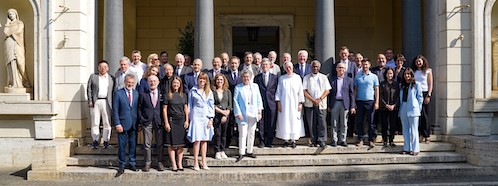
The world stands once again on the brink. Wars rage or smoulder on every continent; the means of annihilation are multiplying; and the bonds of trust that hold societies and nations together are fraying. In Magnifica Humanitas, Pope Leo XIV sets before us two images of the city that human beings build. One is Babel, raised in pride, where a common tongue is shattered and the builders are scattered in mutual incomprehension. The other is the city rebuilt by Nehemiah, raised by those who carry within them the law written on the heart, who recognise in the face of the other a reflection of the face of God, and who are bound to one another not by a power standing above them but by the civic friendship that, in widening circles, can embrace the whole of humanity. These are the two pathways before us. We have gathered to ask how humanity may turn from the first to the second — how, in an age of force, peace may again become not the exception wrung from exhaustion but the ordinary fruit of truth, trust, and the social bond.
I. Truth, Trust, and the Social Bond
There is no social bond without trust. There can be no trust without truth. Endowed with reason and language to seek the truth and to share it with others, human society depends on forging bonds grounded in the respectful communication of truth. Truth is both a gift we receive without exhausting it and a good that is shared, and that weaves the fabric of social life (MH, n. 25). It is, as the Holy Father teaches, not a possession to be monopolised nor a territory to be defended, but a gift that does not fear diversity: it does not eliminate conflicts but transforms them, reuniting what history tends to scatter. To speak rightly of peace, we must therefore begin with truth, and take seriously the human thirst for it, which the factual and scientific truths available to reason alone cannot quench.
Indeed, “in the era of artificial intelligence, when human dignity is threatened by new forms of dehumanization”, taking se
... Read allThe world stands once again on the brink. Wars rage or smoulder on every continent; the means of annihilation are multiplying; and the bonds of trust that hold societies and nations together are fraying. In Magnifica Humanitas, Pope Leo XIV sets before us two images of the city that human beings build. One is Babel, raised in pride, where a common tongue is shattered and the builders are scattered in mutual incomprehension. The other is the city rebuilt by Nehemiah, raised by those who carry within them the law written on the heart, who recognise in the face of the other a reflection of the face of God, and who are bound to one another not by a power standing above them but by the civic friendship that, in widening circles, can embrace the whole of humanity. These are the two pathways before us. We have gathered to ask how humanity may turn from the first to the second — how, in an age of force, peace may again become not the exception wrung from exhaustion but the ordinary fruit of truth, trust, and the social bond.
I. Truth, Trust, and the Social Bond
There is no social bond without trust. There can be no trust without truth. Endowed with reason and language to seek the truth and to share it with others, human society depends on forging bonds grounded in the respectful communication of truth. Truth is both a gift we receive without exhausting it and a good that is shared, and that weaves the fabric of social life (MH, n. 25). It is, as the Holy Father teaches, not a possession to be monopolised nor a territory to be defended, but a gift that does not fear diversity: it does not eliminate conflicts but transforms them, reuniting what history tends to scatter. To speak rightly of peace, we must therefore begin with truth, and take seriously the human thirst for it, which the factual and scientific truths available to reason alone cannot quench.
Indeed, “in the era of artificial intelligence, when human dignity is threatened by new forms of dehumanization”, taking seriously the human thirst for truth amounts to defending our humanity. “We must lovingly safeguard the grandeur of humanity bestowed upon us and revealed in its fullness in Christ, the splendor of which no machine can ever replace. True progress always stems from a heart open to others, an intelligence willing to listen and a will that seeks what unites rather than what separates.” (MH, n. 15)
The human person is not an isolated atom, but a being constituted in and through relationships, and this is the shared wisdom of the great traditions. Magnifica Humanitas invites us to “cultivate what Pope Francis called a ‘situated anthropocentrism’, which recognizes the human being as a creature embedded in a network of relationships with other living beings and with all of creation. Fidelity to the truth requires integrating the possibilities offered by technology within a framework marked by wisdom, which is capable of safeguarding both the dignity of each person and the future of our common home” (MH, n. 237).
The social doctrine of the Church, drawing on Saint Thomas Aquinas, ranks the social virtues — fidelity and gratitude, truthfulness and observance, just exchange and just lawgiving — alongside justice as the bonds that weave the social fabric and that the law alone cannot compel. The Confucian tradition, in Mencius, teaches that peace under Heaven is grounded in concrete human relationships, beginning in the family and radiating outward: to extend one’s care from one’s own kin to the kin of others is enough to keep the Four Seas at peace, while conflict is the fruit of the pursuit of profit over benevolence and righteousness. When the world set down its first common charter of human dignity in 1948, it was an heir of this Confucian inheritance, P. C. Chang, who insisted that the Universal Declaration open with the “spirit of brotherhood,” so that rights might be understood as the outward expression of an inner moral nature shared by all. Across the Axial age and across civilisations the testimony is one: society is made not of individuals or of structures alone, but of relations, and peace is relational before it is anything else.
Trust is the fragile good on which all cooperation rests. We extend it, Aquinas observed, when we believe ourselves to be an object of another’s concern, when we judge the other to be just, when we think the other competent, and when we feel the other to be near rather than distant — and because we tend to measure others by ourselves, the trustworthy more readily trust. What holds between persons holds also between peoples. We therefore distinguish personal trust, built face to face, from institutional trust, which depends on the integrity of those who serve — judges, journalists, scholars, officials, and mediators — and on institutions that are themselves receptive to ethical and relational value. Trust is built and rebuilt over time; it asks of political leaders that they take the past into account and enlarge their vision toward the generations to come. Against the tyranny of the present moment, we must hold past, present, and future together, and refuse the simplification that dismisses law, deliberation, and patient construction as so much wasted time.
In our age truth itself is under assault. The unimpeded circulation of false information polarises opinion, spreads ideology, and damages reputation (MH, n. 132). We have entered a time of what might be called the cloning of truth: selective truth, alternative truth, truth shattered into a plural so that no claim is held to be better than another and the hearers of every message are sorted into mutually hostile tribes. Artificial intelligence now manufactures falsehood at a scale and with a verisimilitude without precedent. When truth is cloned, trust dies; and the death of trust prepares the way for war. To defend the truth — patiently, charitably, and without the harmful simplifications and stereotypes against which the Holy Father warns — is therefore not a merely intellectual task but the first labour of peace. “The truth will make you free”: free from prejudice and from ideology and so drawn closer to one another.
Truth, moreover, is not only spoken but discovered; it is inscribed in the nature of things. While respect for the natural law strengthens the social bond, ethical relativism undermines the very social fabric it claims to liberate; for where nothing is held to be true, nothing can be trusted, and where nothing can be trusted, everything is permitted. Yet even in our “post-truth society” there are signs of recovery. The attention now given to integral ecology brings us back to the order created by God, in which everything is interconnected, and which tells us something of the fullness of reality that we are called to discover ever more closely.
II. Disarming words, disarming AI
Disregard for the truth erodes mutual trust and endangers the social sphere, from the micro to the macro level. Pope Leo’s insistence on disarming language constitutes an appeal to the human heart; his insistence on disarming artificial intelligence is a call to restore humanity to the core of human culture. Disarming AI means freeing it from the mentality of “armed” competition, which today is not limited simply to the military context, but is also an economic and cognitive phenomenon. This entails a race for ever more powerful algorithms and larger datasets, driven by the desire to secure geopolitical or commercial dominance. To disarm means discrediting the assumption that technical power automatically confers the right to govern. To disarm does not mean rejecting technology, but preventing it from dominating humanity” (MH, n. 110)
War is not a fate but a choice. In 2024 the nations of the world spent more than two and a half trillion dollars on their armed forces — the highest sum ever recorded, and the tenth consecutive annual increase — and every dollar of it was debated, budgeted, and voted by lawful governments. This is the plainest measure we possess of a sobering fact: that war is still treated as a legitimate instrument of statecraft, as ordinary a part of the state’s business as the building of roads. Yet what a norm has built, a norm can unbuild. The last century began the slow withdrawal of war’s legitimacy — the renunciation of aggressive war, the Charter’s prohibition of force, the criminalisation of aggression, and now the setting aside of the just-war framework by the very tradition that authored it. To carry that work forward is a precondition of peace, for a world in which every aggressor must disguise itself as a defender has already conceded the principle.
Why, then, do nations so often choose war over settlement? Part of the answer lies in a hard truth about human groups: that while two individuals will usually find their way to cooperation, the groups to which they belong cooperate far less readily, and nations least of all — precisely where the stakes are highest. Between peoples the intimate communication that builds trust is largely absent; differences of language, ethnicity, and religion impede understanding; and it is fearfully easy to dehumanise those one never meets, until the adversary loses his human features and the victims of war are spoken of as vermin to be eliminated. In-group devotion and out-group fear are, tragically, kin.
There is a deeper failure still. Nations act through leaders, whose interests need not match those of the people in whose name they govern. Those who decide on war seldom bear its costs; and a war ruinous for a society can be profitable, or politically useful, for a concentrated few. Demagogues rouse the public to out-group hatred for their own advantage; those who profit from arms keep a permanent thumb on the scale of fear; and a frightened public, told that a war of choice is a war of survival, ratifies where it ought to deliberate. This is the corruption of decision that lies at the heart of the politics of war.
War grows, too, from the collision of claims that no one today is empowered to judge. One nation presses a claim — of divine promise, of power, of self-defence, or of justice for a past wrong — and another presses a contrary claim with equal conviction, and there is no court to hear them. Within a well-ordered society the great majority of disputes are settled not by judges but by the parties themselves; yet they bargain in the shadow of the law, against the backdrop of what a court would decide if they failed to agree, and so their settlements tend toward justice. Strip the court away, as the society of states has done, and diplomacy bargains instead in the shadow of war, against the backdrop of what each side might seize or hold by force. The vision of replacing war with jurisprudence, raised at The Hague more than a century ago, was left a building half-finished: an International Court of Justice whose jurisdiction the powerful may simply decline, and a Security Council paralysed by the veto wherever a permanent member or its client is a party. The instruments of adjudication survive in weakened form; in the gravest disputes they are, for the purpose, absent.
The present disorder was not inevitable. After 1989, as the Holy Father observes, the fall of the communist regimes was followed by a predominantly economic globalisation that lacked an adequate political framework capable of sustaining dialogue and peace (Magnifica Humanitas, n. 201). The opportunity to reduce and at last abolish nuclear arsenals, to gather all the peoples of Europe — Russia among them — within a common framework of security, and to govern the new world market by fair rules of labour, taxation, and care for creation, was very largely missed. Globalisation ungoverned by ethics and politics produced its winners and its losers; the losers, left behind, gave their allegiance to new movements of resentment; and the world began once more to divide into rival blocs that arm against one another. This is the “piecemeal Third World War” of which Pope Francis spoke — not a prophecy of things to come but a description of processes already unfolding, which few have had the courage to name.
III. The Present Dangers
The gravest of these failures is the reversal of nuclear disarmament. The great powers have ceased to reduce their arsenals and have begun instead to modernise them; the architecture of arms control is being dismantled; and the logical end of the non-proliferation bargain — a world freed of these weapons — recedes from view. As it recedes, the bargain itself loses its moral force, for it becomes ever harder to answer why some states may hold such weapons while others may not. A major war among nuclear-armed states would not be a tragedy to be mourned and survived; it would be the end. To halt and reverse this drift is the most urgent task of the age.
At the same time a technological transformation is remaking the human condition faster than our wisdom can govern it. Artificial intelligence threatens to become the monopoly of a technocratic elite that also commands the media and the channels of public discourse, and that is tempted to regard the self-government of equal citizens as obsolete. Its newest systems acquire capabilities their own makers neither designed nor fully control, with grave dual-use dangers in cybersecurity, in weaponry, and in the engineering of disease, while the guardrails lag behind. The same technologies, working upon the human mind, can have an almost narcotic effect — fragmenting attention, shaping and programming desire, and corroding the very relationships that are the deepest infrastructure of human well-being, which no algorithm can supply. Advances in the editing of life itself, and in the fashioning of living matter into machines, press upon ethical boundaries we have scarcely begun to consider. The transformation of work is among the most immediate of these upheavals: the application of artificial intelligence in the workplace must also be made an opportunity to foster trust among employers, workers, governments, and the scientific community, rather than an occasion for the further widening of social divides, with appropriate regulations established so that the benefits of increased productivity contribute to the well-being of the most disadvantaged. Through all of it, human agency must remain at the forefront of every consideration; discernment grounded in wisdom and social justice must guide the most significant scientific advances of our era; and the most vulnerable — above all the young — must be protected, including by a right to disconnect.
IV. Pathways to Peace
If war is what happens when reason, justice, and diplomacy are allowed to fail, then peace is not a wish but a craft and a vocation, and its work can be named. We commend the pathways that follow in the conviction that they are genuinely open to us — and that the reasonable settlement of even the gravest conflicts is more often within reach than the warring parties will admit, blocked not by the obscurity of the solution but by hardliners for whom any compromise is betrayal, and by leaders who dread the loss of face more than they dread the continuation of the killing.
1. Defend the truth and strengthen the public conscience. The public requires a free and genuinely independent press protected both from the state and from those who profit by war; the steady opening of official records and the protection of those who dissent; an honest reckoning of war’s true costs; and a resolute refusal of the cloning of truth and the manufacture of consent. The one court that sits in judgment of every war is the conscience of an informed public, and it can return its verdict in time only if it is not kept in the dark.
2. Build trust deliberately. We must make the mutual gains of cooperation vivid; raise the cost of cheating through monitoring and verification — “trust but verify”; build reputations upon honest, de-propagandised history; bring decision-makers face to face in sustained encounter; and restore reciprocity and gratuitousness to the heart of relations among peoples, against an age that would reduce every bond to a transaction. Peace among nations rests, as Pacem in Terris taught, not on the dread of arms but on mutual trust.
3. Recover diplomacy, mediation, and the culture of encounter. We must pursue the patient art of making the indivisible shareable — through shared or deferred sovereignty, sequencing, and formulas that allow each side to move without seeming to capitulate — and the disinterested mediation that has ended wars where the powerful could not. The reconciliation of Mozambique was won not by force or pressure but by mediators trusted precisely because they sought nothing for themselves, who began from what unites rather than from what divides, and who built, a centimetre at a time, a common language in which an enemy could become an adversary with whom one might yet live.
4. Build the institutions of justice. Let us finish the building that The Hague Process left half-raised: construct, by stages, international courts and arbitrators with real authority over defined classes of dispute, swift enough to rule before a crisis hardens into war; give their verdicts the enforcement without which a judgment is only an opinion; and reform the United Nations and its Security Council so that the guarantor of last resort is no longer disqualified by its own composition from the very cases that most need it. A binding and enforceable judgment is also the assurance that allows a state to concede without surrendering.
5. Disarm and turn the means of war to the works of peace. Let us halt and reverse the new arms race; restore and complete the work of nuclear arms control, with abolition as its horizon; and redirect a share of the world’s vast military spending to the development of the human family — to the education, health, and dignity of the poorest, and to the Sustainable Development Goals. Every reduction in the trillions spent on arms is a withdrawal of war’s legitimacy made concrete.
6. Govern technology for the human person. Insist that human agency, and not algorithmic power, remain sovereign; that the gains of higher productivity serve the most disadvantaged; that the development of artificial intelligence and of the life sciences be subject to ethical discernment and to effective guardrails, above all against catastrophic and irreversible harms; and that the young be shielded from technologies that would consume their attention and their bonds.
7. Reconcile and forgive. There is no peace without justice, but neither is there peace without the slow work of reconciliation. Transitional justice — ordered to the rebuilding of institutions, the recognition of victims, and the restoration of social trust — cannot be reduced to punishment alone, nor to truth commissions without consequence; it must hold together goods that stand in tension: peace and justice, clemency and accountability, stability and truth. Forgiveness, so little used among the instruments of international life, must be recovered; the model we need is less that of Nuremberg than that of truth and reconciliation.
8. Let the religious traditions be peacemakers. The claim of God has too often been made a sanction for war; it must instead become a wellspring of peace. The Spirit of Assisi — born forty years ago and renewed this year — has shown that believers of every faith, together with those of none, can become a people of seekers of peace, emptying conflicts of their violence through friendship, prayer, and common humanitarian labour, from Mozambique to Mindanao.
We do not avert our eyes from the wars now being fought. In each of them a reasonable and just settlement is discernible, and in each it honours together the security and the legitimate rights of all the parties, rather than purchasing the one at the price of the other. We call for the building of regional architectures of security that exclude no people — in Europe and beyond — and for the community of nations to press, steadily and even-handedly, for the settlements that are within reach, refusing the warring parties the indulgence that lets them prefer an endless war to an awkward peace.
From Babel to Nehemiah
We began with two cities, and the choice between them is made not once but daily — in the speeches of leaders, in the verdicts of an informed public, in the patience of negotiators, and in the willingness of ordinary people to see in the stranger a member of the same human family. Peace is a craft, to be learned and practised; and it is also, in the end, a gift, granted to those who prepare their hearts and their institutions to receive it. Let the language of peace replace the language of victory and defeat until it becomes common sense; let the measure of all our endeavours be the face of the most vulnerable; and let us labour, with all people of good will, to turn from the city of Babel to the city built upon the law written in the human heart. Peace, in the end, is the gift of God.
Read Less