

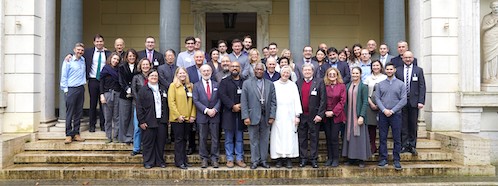
On 19-20th February 2026, the Pontifical Academy of Social Sciences (PASS) and the Oxford Poverty and Human Development Initiative (OPHI) co-organised a workshop on New Narratives and Metrics for Development hosted at the Casina Pio IV in Vatican City. In light of increasing efforts by many actors to measure well-being in ways that go Beyond Gross Domestic Product (Beyond GDP), participants reflected on how multidimensional, counting-based measures of both well-being and poverty might be important tools for contributing to how society understands and measures ‘progress’ in the 21st century. Four dialogue sessions addressed how to move from metrics to tangibly improved well-being via greatly energised communication, proactive and data-based policy, engagement with multiple international processes, and more and better well-being data.
Inspired by the Catholic Social Teachings of Integral Human Development, as well as Amartya Sen’s Capability Approach and Bhutan’s concept, measure, and policies to advance Gross National Happiness (GNH), the workshop brought together leaders and thinkers with diverse expertise to explore measures that could combine theological coherence with methodological rigour and practical usefulness for government policy and community action. Some points of the assembled community are summarised below.
Beyond GDP and Catholic Social Teaching
After Cardinal Peter Turkson’s welcome, Sister Helen Alford, President of PASS, opened the workshop by observing the tension between two fond phrases: the need to ‘measure what we treasure’ and the sense that ‘what really counts can’t be counted.’ The workshop directly probed that creative tension. She spoke of how measuring well-being Beyond GDP resonates conceptually with Catholic Social Teaching and current priorities. Since the 1967 encyclical Populorum Progressio of Pope Paul VI, the concept of ‘Integral Human Development’ within Catholic Social Teaching has summarised a broader definition of human flou
... Read allOn 19-20th February 2026, the Pontifical Academy of Social Sciences (PASS) and the Oxford Poverty and Human Development Initiative (OPHI) co-organised a workshop on New Narratives and Metrics for Development hosted at the Casina Pio IV in Vatican City. In light of increasing efforts by many actors to measure well-being in ways that go Beyond Gross Domestic Product (Beyond GDP), participants reflected on how multidimensional, counting-based measures of both well-being and poverty might be important tools for contributing to how society understands and measures ‘progress’ in the 21st century. Four dialogue sessions addressed how to move from metrics to tangibly improved well-being via greatly energised communication, proactive and data-based policy, engagement with multiple international processes, and more and better well-being data.
Inspired by the Catholic Social Teachings of Integral Human Development, as well as Amartya Sen’s Capability Approach and Bhutan’s concept, measure, and policies to advance Gross National Happiness (GNH), the workshop brought together leaders and thinkers with diverse expertise to explore measures that could combine theological coherence with methodological rigour and practical usefulness for government policy and community action. Some points of the assembled community are summarised below.
Beyond GDP and Catholic Social Teaching
After Cardinal Peter Turkson’s welcome, Sister Helen Alford, President of PASS, opened the workshop by observing the tension between two fond phrases: the need to ‘measure what we treasure’ and the sense that ‘what really counts can’t be counted.’ The workshop directly probed that creative tension. She spoke of how measuring well-being Beyond GDP resonates conceptually with Catholic Social Teaching and current priorities. Since the 1967 encyclical Populorum Progressio of Pope Paul VI, the concept of ‘Integral Human Development’ within Catholic Social Teaching has summarised a broader definition of human flourishing than that captured by measures of economic development. The concept has aimed to incorporate spiritual and moral dimensions alongside physical, economic, social and cultural dimensions in the analysis of societal progress and human experience.
Last October in Dilexi Te (13), Pope Leo XIV highlighted how:
‘there are many forms of poverty: the poverty of those who lack material means of subsistence, the poverty of those who are socially marginalized and lack the means to give voice to their dignity and abilities, moral and spiritual poverty, cultural poverty, the poverty of those who find themselves in a condition of personal or social weakness or fragility, the poverty of those who have no rights, no space, no freedom.” Dilexi Te (9)
He pinpointed some of the issues behind focusing on economic wealth alone when he wrote:
‘…the illusion of happiness derived from a comfortable life pushes many people towards a vision of life centered on the accumulation of wealth and social success at all costs, even at the expense of others and by taking advantage of unjust social ideals and political-economic systems that favor the strongest.’ (11)
These insights powerfully reinforce the need to look beyond monetary metrics alone, and place human dignity and Integral Human Development at the centre of our metrics. This approach has been emphasised conceptually by Amartya Sen’s capability approach, which underlies people-centred and policy-oriented human development. In the face of widening inequality, rising conflict, climate threats and environmental degradation, the Beyond GDP movement seeks new metrics for well-being.
Measuring Integral Human Development: the focus of this workshop
Participants included distinguished members of the High-Level Expert Group on Beyond GDP (HLEG) who have been tasked by the UN Secretary General to propose a new framework comprising ‘a limited number of country-owned and universally applicable indicators of sustainable development that complement and go beyond GDP’ in 2026. In addition to academics representing the Universities of Peru, Florence, George Washington, Meikai, Rome, Indonesia, Universidad Nacional del Sur (UNS) (Argentina), Harvard, Bologna and Oxford, the workshop was also attended by distinguished colleagues from institutions including the Dicastery for Human Development, UN DESA and Statistics Division, the Expert Group on Well-being Measurement, the Beyond Lab, the Beyond GDP Global Alliance, the Economy of Francesco, the Institute of Economics and Peace, the Gallup World Poll, United States Chapter of the Committee of Pan-American Judges for Social Rights and the Franciscan Doctrine, OPHI, and the Belonging Forum. The former PASS Chancellor, current and past President, Ordinary and Honorary Academicians of PASS, and post-doc scholars affiliated with PASS (including the Istituto Nazionale di Statistica of Italy) also attended to share their insights.
The workshop discussed how well-being measures need to be intentionally constructed to meet policy and contextual needs. James Foster offered the Multidimensional Poverty Index (MPI) as an example of a metric that fulfils key axioms and proto-axioms for policy – and in the case of the global MPI is estimated for over 100 countries annually by OPHI and the United Nations Development Programme. Participants heard how bespoke official national MPIs reflecting national definitions of poverty have been published by over 55 countries and how Amartya Sen’s capability approach, which underpins the MPI, offers a key source for conceptualising well-being and its measurement.
This workshop considered how – besides dashboards and composite indices – well-being metrics, and policies and processes to advance well-being, might be catalysed using counting-based measures of well-being and/or of multidimensional poverty. The small land-locked Himalayan country of Bhutan has been a pioneer in the measurement of multidimensional well-being across nine domains for policy use. After a series of consultations and trials, Bhutan has measured GNH – Gross National Happiness – since 2010 using an innovative adaptation of the MPI methodology. GNH has been used to guide policy and programme design and assessment. Yet Bhutan’s example has been largely overlooked in discussions of well-being metrics. The workshop probed how counting-based measures, like Bhutan’s, might contribute to new international and/or national standards for measuring development that are fit for purpose in the 21st century.;
Bhutan’s Gross National Happiness Index – which includes indicators of spirituality and culture – grounded the discussion in a Buddhist country which built its GNH index via deeply consultative processes to balance material and spiritual aims. Other papers presented national Multidimensional Well-being Indices (MWIs) built from datasets in Argentina, Chad, Comoros, Indonesia, Iraq, Japan, Malawi, Peru, USA, and 144 countries (using the Gallup World Poll). These presentations demonstrated methodological options and empirical findings for various sufficiency cutoffs, types of weights, cross-dimensional cutoffs, and combinations of objective and/or subjective indicators.
The Argentinian example illustrated how varying sufficiency cutoffs affect results, illustrating how sufficiency cutoffs can reflect national policy goals. The Chad-Comoros-Iraq paper built an individual-level moderate Multidimensional Poverty Index (MPI), then augmented it with dimensions of subjective well-being and safety from violence to create a Gross Well-being Index and illustrated how these shifted rankings. For example, in one subnational region of Chad, women’s higher subjective rankings led to statistically significantly higher well-being for women than men. An extensive study in Malawi showed how a far richer dataset could build a more apposite MWI, and also illuminated how the poorest regions in Malawi had ‘pockets’ of well-being due to stronger community and environmental attainments. A small new dataset in the USA covered six of the seven HLEG domains, and applied five weighting schemes, finding that in that dataset, subjective regression weights were flawed, and also would lead to highly altered targeting outcomes. An extensive effort in Indonesia built a MPI and MWI and studied extensively disaggregated results, crossing these also with subjective well-being and monetary quintiles, and analysing intra and intercorrelations between subjective and objective indicators. Inspired by Bhutan’s example, Peruvian data was gathered to match the national ‘agreement’ on Peru’s vision for the future. It also tested weights from survey-based data and found that these coincided with equal normative weights across dimensions. Japan has been a leader in well-being measurement since the 1970s; this paper for the first time created a counting-based MWI both from the official subjective well-being indicators and from the official subjective and objective indicators together, demonstrating its value-added compared to a dashboard. Finally, a 144-country study using core questions from the Gallup World Poll illustrated what could be done and compared over time using existing data. Its findings observed the absence of some variables relevant for HLEG measurement in the core questionnaire, as well as its limited disaggregation possibilities, and invited further engagement.
The first of four thematic dialogue sessions raised issues of communication probing how to share the results of multidimensional well-being metrics so that they are intelligible and accepted across a broad range of audiences across society including youth, the private sector and all parts of government (recalling that GDP is a relatively recent event on the world stage). Discussions ranged from using tools such as an App, to engaging with the voice of Youth movements, to the conceptual lens which values (and measures) the ‘commons’ within any framework, to how Augustine’s City of God could animate the second City. The second dialogue addressed policy: observing how counting-based measures could add policy information. The dialogue commended census data as a starting point for further empirical analysis. Learning from the Positive Peace concept, which focuses on the necessary conditions for peace and society to flourish, the dialogue highlighted the importance of investment in dissemination that engages the public emotionally and intellectually, as well as how ‘sowing seeds’ among advocates can generate bottom-up changes quickly that complement intergovernmental processes. A third dialogue on processes, detailed the High-Level Expert Group on Beyond GDP’s interim report (in which the global MPI is proposed for inclusion in the dashboard of Equity), and how multiple ‘aggregation’ methodologies need to collaborate intentionally. Other key processes for engagement in the Beyond GDP project were highlighted including the SDG Summit in 2027, the Pact for the Future review in 2028, as well as the Beyond GDP Alliance and dialogues in the UN Statistics Commission. A dialogue on data distilled key considerations that could be learned from over 15 years of experiences of well-being data collection, and possibilities in the short- and medium-term for real progress. On the sobering side, it was noted that at present, comparable and highly disaggregated data for HLEG or Bhutan’s domains remain a binding constraint; more progress remains to be made in gathering additional data across countries, on certain indicators for Beyond GDP. In the short term, focusing on national multidimensional well-being measures offer feasible routes to exploring further the value added of these frameworks.
The workshop’s deliberations may be useful for actors focused on the measurement, analysis and nurture of Integral Human Development. This could be through the Beyond GDP alliance, through encouraging or working on the development of official national multidimensional well-being statistics to guide policy, or through private sector or community initiatives springing from personal reflection of the insights that well-being metrics offer. The creation of new standards for what Honorary PASS Academician Joseph Stiglitz termed ‘measuring what we treasure’ is a shared project, which relies on the collective energies of many hearts.
Key Reflections
Some of the areas for action and reflection that emerged from the discussions and exchanges on well-being metrics are:
1. Spirituality as a domain: According to Gallup World Poll data, the global median share of adults who say religion is an important part of their daily life reached 83% in 2024, underscoring how widespread spiritual and religious dimensions remain in lived experience. The Pew Research Center had similar findings, suggesting that much of the world’s population is associated with some religious or spiritual traditions and some of these offer a transcendent dimension which may extend across time and space into eternity. And Faith-based groups in many contexts intentionally nurture multidimensional well-being; there is growing causal evidence from the Global Flourishing Study initiative that there is a causal link between it and multidimensional well-being. It seems possible and perhaps constructive not to excise spirituality from the definition of well-being, even if important tensions and research questions remain about how to measure it. A related need is to think about how to introduce theological coherence and spirituality naturally into international as well as national discussions.
2. It’s in a name: Participants recognised that a well-being index with a wider social following needed a simple, resonant name that could garner public support and acceptance. Having considered options such as Gross Well-being Index (GWI), Multidimensional Well-being Index (MWI) and Flourishing and Well-being Index (FWI), the group considered a more intuitive name ‘Welly’ (Welly Index, or Welly-I, or Welli). The word ‘Welly’ has an evident and direct resonance with the word ‘well-being’. The association with wellington boots in some cultures brings to mind children and adventure; the British phrase ‘give it some welly’ conveys impetus and direction. More discussion is required, but in a crowded statistical landscape an engaging and credible name will be necessary.
3. Counting-based/Multidimensional Well-being Indices have policy traction: Learning from Bhutan’s example with GNH, as well as from the policy uses of Multidimensional Poverty Indices (MPIs) when used as official national statistics, it is clear that having a Multidimensional Well-being Index goes far beyond country ranking and can direct policy. Key features are that it can be disaggregated subnationally, and that it shows both the shape of well-being and the tangible actionable areas required to improve well-being, indicator by indicator. In addition, a Multidimensional Well-being Index improves when any insufficient attainment in any indicator belonging to any person who lacks well-being is improved – and of course the methodological requirements of standard errors, robustness tests and so forth are well documented.
4. Which well-being measure to use and when? Composite, Utilitarian and Counting-based measures each have unique data needs, advantages and challenges. A constructive and feasible next step is to bring different actors together for a highly technical exchange, with the aim of coming to a common agreement on which methodology should be used when, as collaboration between these actors could be a force for good to unite efforts that are otherwise dispersed. The group reflected on the importance of collaborative exchange between existing groups focused on advancing well-being measurement. The group also reflected on how more discussion was required of the purpose and advantages of global measures offering rankings to catalyse advocacy, alongside national metrics providing actionable information for interventions. The group discussed how such indicators, if well designed, could contribute not only to monitoring progress but also to informing policy and financing decisions, particularly in contexts where GDP per capita masks structural fragilities.
5. Using poverty and well-being lenses together: A number of presentations overlaid Multidimensional Poverty and Multidimensional Well-being Indices. Results showed that sometimes measures coincided. Other times, the poorer regions showed higher well-being, because of harmony with the environment, or strong community relationships, or strong spiritual and psychological well-being. There seems to be interest from a number of countries in generating both measures – although the political urgency of poverty measures may be clearer. It was recognised that subjective indicators have been the subject of extensive research relating to aggregate measures; their aptness for cross-country comparisons using counting approaches remains debated. More research may be needed on subjective indicators in counting-based approaches which focus on the joint distribution of indicator sufficiency for the individual.
6. Transparency: It was recognised that one fundamental value of dialogues regarding well-being measurement in all methodologies is transparency. The methodology (indicator selection, weights, cutoffs, data transformations etc) should be transparently shared such that others can understand, replicate, and if needed criticise or adjust it. For instance, the group discussed weights and optimal ways of advancing methodologically based on the early evidence presented in the empirical presentations.
7. Capability and freedom: Freedom is a core value of the Catholic Social Teaching and other approaches. The multidimensional well-being methodology includes freedom – and recognises the diversity of individual vocations and conditions – by setting a cross dimensional cutoff that recognises well-being if there is a critical mass of sufficient attainments. Building space for freedom into well-being measures – as Sen commends – seems a positive contribution that is distinctive of counting-based approaches.
8. Data for adequate Multidimensional Well-being Indices: Participants discussed the short-term and medium-term options to break out of the 'data prison' that constrains construction of globally comparable measures of well-being. The Gallup World Poll, for example, does not cover all of the indicators currently proposed by the HLEG and at the moment cannot be disaggregated by key variables for policy such as subnational regions (states or provinces), disability status, or ethnicity. Progress at the global scale therefore seems uncertain in the short term. However, constructing trial Multidimensional Well-being Indices from existing data – for example using censuses – would be feasible in the short term, as would work by national statistics offices to construct official national Multidimensional Well-being Indices. Looking ahead to the day in which multiple data will be merged at the individual level, it is vital to begin to ensure that data are correctly curated. It was also noted that an International Expert Group/Commission on Well-being standards with long-term funding is essential. Finally, with Integral Human Development in mind, special research may be needed (household or neuroscience) to track the development of pro-social spirituality and the ensuing human abilities.
Read Less