

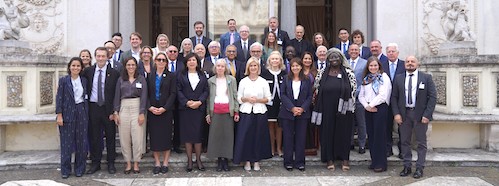
We, the participants in the "Building Climate Resilience Legislation Summit," held in Vatican City on May 12, 2026, hosted by the Pontifical Academy of Social Sciences, affirm our commitment to advancing climate resilience legislation, recognizing our ties to diverse stakeholder communities from Africa, the Americas, Asia, and Europe. Our endeavors are an integral part of the PASS global regional climate summits. Our work focused on the practical realities of drafting, passing, and implementing such legislation.
We are experienced legislators, emerging political leaders, policy experts, and judges focused on concrete examples of how climate-resilience laws, both codified and customary, have been successfully passed and implemented—mindful of how they can be applied across jurisdictions. We shared what we have learned about implementing effective political and legislative action. We heeded His Holiness Pope Leo XIV’s urgent call: “It is time to move from words to action.”
We emphasized the disproportionate threats climate change poses to the most vulnerable citizens across the regions we represent, despite their minimal contribution to global greenhouse gas emissions. In light of this, we reiterate the urgency of placing climate-resilience legislation—particularly at the local and regional levels—at the heart of the global climate agenda.
We, participating judges, legislators, parliamentarians, mayors, governors, and local leaders from across continents, reaffirmed the central role of decentralized governance in advancing climate resilience. We offered legislative testimony alongside elected officials and policymakers from regions where the Pontifical Academies are hosting global summits, and we shared firsthand accounts of the strategies that helped them pass effective climate-resilience legislation.
Background
On May 12, 2026, PASS convened legislators, governors, mayors, judges, and policy experts to focus on the practical realities of drafting, passing, and imple
... Read allWe, the participants in the "Building Climate Resilience Legislation Summit," held in Vatican City on May 12, 2026, hosted by the Pontifical Academy of Social Sciences, affirm our commitment to advancing climate resilience legislation, recognizing our ties to diverse stakeholder communities from Africa, the Americas, Asia, and Europe. Our endeavors are an integral part of the PASS global regional climate summits. Our work focused on the practical realities of drafting, passing, and implementing such legislation.
We are experienced legislators, emerging political leaders, policy experts, and judges focused on concrete examples of how climate-resilience laws, both codified and customary, have been successfully passed and implemented—mindful of how they can be applied across jurisdictions. We shared what we have learned about implementing effective political and legislative action. We heeded His Holiness Pope Leo XIV’s urgent call: “It is time to move from words to action.”
We emphasized the disproportionate threats climate change poses to the most vulnerable citizens across the regions we represent, despite their minimal contribution to global greenhouse gas emissions. In light of this, we reiterate the urgency of placing climate-resilience legislation—particularly at the local and regional levels—at the heart of the global climate agenda.
We, participating judges, legislators, parliamentarians, mayors, governors, and local leaders from across continents, reaffirmed the central role of decentralized governance in advancing climate resilience. We offered legislative testimony alongside elected officials and policymakers from regions where the Pontifical Academies are hosting global summits, and we shared firsthand accounts of the strategies that helped them pass effective climate-resilience legislation.
Background
On May 12, 2026, PASS convened legislators, governors, mayors, judges, and policy experts to focus on the practical realities of drafting, passing, and implementing climate resilience legislation. By sharing concrete examples of successful climate resilience laws and lessons that can be applied across jurisdictions to drive effective political and legislative progress, we heed the urgent call from His Holiness Pope Leo XIV to “move from words to action.”
The summit was the eighth in the regional series following the Call to Action for Climate Change Resilience, signed by Pope Francis in May 2024 at the Apostolic Palace. Subsequent summits were held in Brasilia, Boston, California, Dakar, Nairobi, the Vatican, and Vienna, with additional summits planned for India and in the Philippines, including Southeast Asia & the Pacific. We aim to culminate in a final comprehensive Vatican Summit in 2027 and the release of a Universal Protocol for Climate Resilience.
Conceptual Framework
The strategic orientation animating the global summits is rooted in Mitigation, Adaptation, and Societal Transformation (MAST), the three pillars of the PAS/PASS framework for building Climate Resilience:
- Mitigation: To bend the GHG emissions curve downward now and reach climate neutrality by 2050, thereby limiting warming to below 2°C, is the first Pillar of MAST.
- Adaptation: Adaptation to unavoidable climate change is the second pillar of MAST. It involves reducing sensitivity to climate change, reducing exposure to climate-related risks, and enhancing adaptive capacity. Adaptation must begin at the local level, in a city, a village, or a state, and scale up to the national level.
- Societal Transformation: Transitioning to a sustainable way of living is essential for both reducing anthropogenic perturbations (bending the curve) and thriving despite climate impacts. Societal transformation involves fundamental shifts in values, behavior, and the governance of socio-economic systems. In Pope Francis’ words, “This transformation is akin to an ecological conversion.”
Lessons Learned
All Resilience is Local with Global Implications
Coverage of climate resilience legislation worldwide now includes 1,500 national frameworks and more than 7,000 subnational policies. Effective implementation requires integration across sectors, financial mechanisms, and accountability frameworks. Key examples include:
- Innovative projects in Hong Kong, such as mobile flood-response pumps, underground stormwater storage, urban forestry, and river-corridor naturalization;
- California’s cap-and-invest program covers 58% of global GDP and 18% of emissions, demonstrating the potential of market-based carbon pricing mechanisms.
- The EU’s ‘Fit for 55’ package is a comprehensive policy toolkit addressing transportation, energy, industry, and social equity.
Kenya’s governance structure comprises 47 county governments, forming the foundation for localized climate action planning and implementation. Vihiga County has 25 wards, each serving as a critical unit for planning and implementing climate interventions, supported by an overarching climate steering committee, a multi-sectoral climate change planning committee, and a Directorate of Climate Change to coordinate implementation and monitoring. Vihiga has institutionalized a Climate Change Fund that allocates at least 2% of its annual development budget to climate action, with community-driven climate risk assessments guiding action plans and ensuring accountability. Successful projects include the restoration of hundreds of acres of degraded land, solar-powered water schemes, irrigation, aquaculture, and infrastructure rehabilitation after flooding. Monitoring and evaluation frameworks track climate funding and impacts, with annual reporting to county and national authorities.
Scalable solutions introduced by visionary leaders inspire action globally. Paris’s climate strategy was implemented as a long-term policy with measurable outcomes:
- reducing car usage (95% of public space was dedicated to cars)
- expanding bike lanes
- increasing green spaces
- social housing
- pedestrianizing streets
Combined, these measures resulted in a 50% reduction in air pollution - saving thousands of lives annually.
When central governments do not act, regional governments can partner to drive change. As we learned from Massachusetts legislators, 11 states formed the Regional Greenhouse Gas Initiative, the country’s first mandatory, market-based cap-and-invest program to reduce carbon dioxide emissions from the power sector. Emissions have been reduced by more than 46%, and more than $9 billion in proceeds have been invested in clean energy and consumer-benefit programs.
Looking Beyond the Horizon
Massachusetts’s legislature first enacted legally binding environmental legislation in the early 2000s, committing to net-zero emissions by 2050 and setting clear benchmarks. This marked the start of a 20-plus-year process of continual improvement and deliberative action, including investments in clean energy, offshore wind, energy efficiency, transportation electrification, and regional collaboration across borders.
The same model for success that has benefited Massachusetts also applies to Paris, Vihiga County, Kenya, and California– visionary, stable government that establishes clear, durable policies that endure even when political or economic factors change. Steady leadership from a legislature, mayor, or governor that thinks beyond one election cycle will yield meaningful achievements.
Judicial Decisions: Shifting Norms & Behavior
Legal frameworks, including climate laws and judicial rulings, establish binding obligations for governments to act, protect human rights, and ensure accountability, including for future generations. Judicial decisions lend moral authority, raise public awareness, and generate political pressure, even when immediate compliance is uncertain. Litigation plays a dual role: it can protect the environment but also provoke resistance. Three central questions guide the courts' role:
- May courts intervene -- Legitimation
- Should courts intervene -- Political and institutional appropriateness
- If so, what can courts realistically achieve -- Effectiveness and added value
As to question (1), the legitimacy of the courts’ intervention in climate change issues – particularly in the form of judicial review of legislation – is disputed, as there is often no clear legal basis in the text of constitutions and human rights charters on this matter. However, there is a general trend in favor of judicial intervention, directly based on the State’s ratified international obligations, or – alternatively – on specific constitutional or charter provisions that can serve as legal bases for courts’ intervention in climate change matters, thanks to an evolutive interpretation of the relevant text (for example, Articles 2 and 8 of the ECHR), with an emphasis on the protection of the interests and rights of future generations.
As to question (2), the case for judicial restraint in policies requiring complex balancing among competing interests is, admittedly, strong: political actors are, in general, better placed to make these assessments. However, it is arguable that counter-majoritarian interventions by courts are necessary to protect the most vulnerable sectors of society that are most exposed to the adverse effects of climate change. Younger and future generations have no voice in the political process. Yet their interests and rights could be easily and irreparably impaired by the current political powers’ reckless choices.
As to question (3), one must finally wonder whether the court’s intervention, albeit legitimate and appropriate, can also be effective, given that courts have no control over the substantial financial investments necessary to pursue a sensible climate change agenda. The crucial question for courts is how to ensure compliance with their judgments, particularly when those judgments spark adverse reactions among segments of the public and among political actors. Despite these difficulties, it seems that courts’ judgments, particularly those from top national or international courts, can play a significant role even if they are not immediately complied with. Indeed, they can help raise awareness and provide compelling arguments to those political forces, NGOs, sectors of society, and the media that are willing to fight for greater public engagement on this emergency.
In sum, courts can and should be actors in a broad alliance among different stakeholders, including members of civil society and, of course, religious institutions such as the Catholic Church, advocating for urgent action by political actors.
Since early 2019, the UN Environment Programme has advanced a conceptual framework first outlined in Environmental Rule of Law: First Global Report. This reflects an ambition to ensure that substantive environmental law reform is linked to the rule of law, thereby encouraging adequate, implementable laws, access to justice and information, public participation, equity and inclusion, and accountability and transparency. This was re-emphasized and evaluated at the Second Inter-American Congress on Environmental Law and in a follow-up assessment in November 2023. Most recently, on May 21, 2026, the UN voted 141-8 to adopt a resolution supporting the International Court of Justice’s advisory opinion on climate change. The advisory opinion holds that States are obliged to reduce fossil fuel use to tackle global warming. The advisory opinion was requested by small nations, including Vanuatu, a South Pacific archipelago made up of 83 islands. This is a significant resolution that is likely to influence future climate change litigation.
After being rejected by Swiss courts, Senior Women for Climate Protection Switzerland’s decade-long legal and activist campaign culminated in the European Court of Human Rights’ groundbreaking April 2024 ruling, which recognized climate inaction as a human rights violation. The ruling has influenced national courts across Europe and inspired litigation worldwide to protect citizens and future generations from harm. It has set a precedent with far-reaching implications for human rights, global solidarity, and future generations. National courts in Germany, Italy, and Sweden have applied the principles established by the ECHR decision. The ECHR has also ruled that legislation must be capable of mitigating both existing and potentially irreversible future effects of climate change.
The UK Supreme Court ruled in the landmark Finch case that planning authorities must consider the full downstream impact of climate change on fossil fuel extraction when assessing the environmental impact of new oil and gas projects. This decision has spurred further litigation and has the potential to shift public attitudes and government behavior regarding climate change policies.
In Peru, specialized courts with environmental jurisdiction have been established across various regions of the country, strengthening judicial protection in the face of socio-environmental conflicts. The National Commission on Environmental Management and the Environmental Justice Observatory were created to support coordination and the monitoring of environmental issues. The signing of the Madre de Dios Pact for Environmental Justice, presented to Pope Francis in 2018, reaffirmed the commitment to access to social and environmental justice, the protection of fundamental rights, and a more effective response to environmental conflicts. Judicial actions and landmark cases illustrating environmental justice in Peru include:
- Prohibiting large-scale hydrobiological extraction in protected natural areas, such as the Nazca National Reserve, which has ancient cultural heritage and significant biodiversity
- Authorities were ordered to implement a recovery plan with defined deadlines to address contaminants, wastewater, and health risks in the polluted Yarinacocha Lagoon
- The Marañón River and its tributaries, recognized as legal rights holders, affirming:
- The river’s right to exist, flow without pollution, and preserve its ecosystems
- Indigenous communities as legitimate guardians and representatives
- The right to restoration or reparation for harm caused
These rulings are historic milestones in Peruvian environmental law, incorporating indigenous cosmologies that regard nature as a living system with rights rather than as mere resources.
Sustainability is integrated into the institutional governance of the Brazilian Superior Court of Justice, which maintains a dedicated Sustainable Management Advisory Unit staffed by a full-time team committed exclusively to environmental issues.
The judiciary plays a critical role in applying criminal and civil penalties under existing law that support environmental protection, restoration, and resilience measures and deter future damage. For example, two case studies in the United States:
1. Following an oil spill that killed protected species and damaged ecosystems, the operator was criminally charged under the Clean Water Act and the Migratory Bird Act, with penalties including:
- Probation conditions
- $10 million monetary penalty, $8 million recommended for wetland conservation projects in the spill area
- An additional civil suit settlement secured over $19 million
2. A bus company that violated the Clean Air Act and Massachusetts anti-idling laws by idling buses for more than five minutes paid a nearly $6 million settlement, introduced emission-reduction technology, and improved driver training.
The Inter-American Court of Human Rights' advisory opinion marks a major advancement in regional climate justice by establishing binding judicial standards that recognize the complex, transboundary nature of climate change. The framework provides regional judges with precedent to advance ecological and planetary dignity and to contribute meaningfully to climate justice.
In a recent advisory opinion, the International Court of Justice (ICJ), the highest judicial authority within the UN system, clarified that states must:
- Establish a national system, including legislation and regulations, to address climate change.
- Regulate private actors, administrative procedures, and enforcement mechanisms
- Exercise adequate vigilance to ensure these systems function effectively.
The International Tribunal on the Law of the Sea adds that states have a duty to prevent, reduce, and control marine pollution, including greenhouse gas emissions, in line with the Paris Agreement's 1.5°C goal. This institutional trend reinforces the view that the net-zero emissions target by 2050 is a legal mandate rather than a political ambition. The German Federal Constitutional Court ruled that deferring heavy mitigation measures to the future discriminates against the young and violates constitutional freedoms.
The Asian Development Bank’s partnership with the Royal Academy for Justice to develop Cambodia’s first comprehensive judicial curriculum on environmental law and case management led to a multi-year program that trained the first cohort of judges in applying environmental law, interpreting scientific evidence, and judicial pedagogy.
The Asian Judges Network on the Environment is also a first-of-its-kind platform that fosters judicial capacity building and multilateral exchange. It addresses the need for peer judicial networks to tackle complex 21st-century environmental challenges.
This evolving jurisprudence shifts the narrative from political or scientific debate to legal duties and accountability.
Aligning Resilience and Economic Development
Legislation that incentivizes a clean energy transition has spurred historic private-sector investments in renewable energy and created green jobs. Market forces will continue to drive the clean energy transition. For example, in Germany, many coal-fired power plants have become economically unviable and are being phased out, accelerating renewable energy deployment. Similarly, energy crises triggered by wars in Ukraine and Iran have accelerated renewable energy deployment. Streamlining permitting processes can expedite implementation, as evidenced by the German state of Baden-Württemberg, where approval for wind power plants was reduced from 38 months to 7 months after legislative reforms, greatly speeding up renewable energy expansion.
The Inflation Reduction Act is the largest U.S. investment in climate resilience, driving rapid growth in solar, wind, battery production, electric vehicles, and supply-chain diversification. It has spurred $600 billion in private-sector investment and created more than 400,000 jobs. In California, producers of single-use plastic packaging must take responsibility for the entire waste lifecycle and set reduction targets. By 2032, all packaging sold in California must be recyclable or compostable. Crucially, the law incentivizes companies to design more sustainable packaging. Early results are promising: Styrofoam food-service packaging is no longer sold in supermarkets. In Massachusetts, Mass Save helps families and businesses reduce energy consumption, lowering costs and carbon emissions. A public-private Climate Careers Fund – seeded with $5 million from the state and matched by philanthropic and private funding – is designed to train 34,000 workers for clean energy and climate-critical jobs through zero-interest loans that cover unmet training-related costs, including tuition, fees, and equipment. The Massachusetts Community Climate Bank is the nation’s first green bank dedicated to decarbonizing affordable housing, with $50 million in initial state funding to attract private-sector capital.
Strategic Investments for Financing Resiliency
Climate finance remains a significant challenge, particularly in vulnerable regions such as Africa and the Asia-Pacific, and requires innovative mobilization of public, private, and philanthropic capital. In Africa, only 3% of the required funds have been made available to address the climate crisis. Four case studies of World Bank-supported projects in Africa underscore the importance of decentralized climate finance, simplified access, local leadership, and strengthened institutional capacity.
Case Study Location |
Project Name |
Budget (USD) |
Focus Areas |
Key Outcomes |
Madagascar |
Mondo Support to Resilient Livelihoods |
$200 million |
Flood & drought resilience, food security, marginalized groups |
1M+ improved infrastructure access, 60% improved livelihoods |
Northern Mozambique |
Rural Resilience Project |
$150 million |
Vulnerable communities, climate disasters response |
Strengthened local institutions |
Refugee camps |
Turikum |
$60 million |
Micro-entrepreneurs, climate-resilient livelihoods |
Simplified finance access critical |
Burundi |
Bundi Climate Resilience Investment Project |
$100 million |
Fragile communities, data-driven planning |
Developed community-level plans |
In the European Union, the Social Climate Fund ($65 billion) becomes available once Member States submit tailored plans detailing how they will deploy the resources for energy efficiency measures, building renovations, the installation of heat pumps and solar panels, and zero- or low-emission mobility. The Just Transition Fund ($20 billion) provides targeted support to regions facing significant socio-economic challenges arising from the transition to climate neutrality, helping ensure economic and social resilience in those areas.
The Asian Development Bank (ADB) helps countries strengthen the legal foundations for long-term climate action by:
- Finance: Infrastructure and renewable resource investments
- Partnerships and knowledge transfer: Strengthening enabling environments
- Mobilizing private capital at scale: Critical for implementing solutions
- Fiji’s Climate Change Act of 2021, supported by ADB technical assistance, is one of the most comprehensive climate laws worldwide, effectively turning ambition into protection for people and ecosystems by:
- Whole-of-government risk assessments
- Carbon budgeting
- Climate risk disclosures
- Innovative insurance mechanisms supporting community relocation
Addressing Challenges and Opportunities
While navigating the legislative process to implement resilience legislation is complex, requiring coalition-building among diverse stakeholders, balancing multiple interests, and upholding democratic processes, the results can yield lasting, meaningful measures that improve lives.
A careful balance must be struck among competing priorities, including emissions reduction, renewable energy, electric vehicles, cost-of-living pressures, job transitions, political resistance, and misinformation campaigns. However, emerging narratives that frame climate change as an economic opportunity, security, and well-being, rather than as an environmental or partisan issue, may be more persuasive to the public. As dependence on fossil fuel imports is now seen as both costly and risky, this reinforces the need for a clean energy transition.
Climate resilience need not be a partisan issue because the negative consequences of inaction affect us all. Political alignment facilitates long-term climate legislation and its implementation. In fact, addressing resilience is critical for economic stability, intergenerational equity, safety, and national security. Specifically, the implications of melting Arctic ice and a weakening Gulf Stream render large regions uninhabitable.
Philanthropic and academic institutions play key roles in data collection, as purveyors of truth, in advocacy, and in fostering cross-sector collaboration to advance climate resilience
Resilience is a Public Health Issue
In Laudato Si (2015), Pope Francis argues that the most vulnerable and the poorest are likely to suffer the most from climate change because of socioeconomic inequality. Public health issues are intertwined with poverty, global food insecurity, and access to medicine. Climate resilience must protect the most vulnerable holistically to ensure it addresses their needs. The health impacts of climate change provide a powerful, tangible narrative to engage the public and policymakers, linking climate action directly to human well-being and economic stability. Climate change is an ultimate threat multiplier that exacerbates existing health risks, especially for the elderly, the poor, and children. Extreme heat, drought, and floods cause significant health and economic impacts. Research reveals disparities, such as urban heat islands and a lack of green spaces, that disproportionately affect schools serving poor and underrepresented youth, prompting urban adaptation. Air pollution from fossil fuels causes 600,000 premature deaths annually in Europe, yet fossil fuels remain heavily subsidized by governments. In contrast, Iceland’s renewable energy model, which uses hydro and geothermal for electricity and heating, though costly initially, now underpins the economy and environmental sustainability.
Climate change is reshaping the geography of infectious diseases. In Europe, 5 million more people are at risk of vector-borne diseases each year. Diseases such as dengue and chikungunya are appearing in Europe and North America. Malaria is spreading to higher altitudes, and an increase in zoonotic spillovers (animal-to-human disease transmission) is contributing to pandemic risks. Improvements are needed in the education and training of health professionals, including the integration of climate into health curricula.
Health is described as the “human face” of climate change, making abstract environmental risks tangible and motivating action. Shifting from diagnosing problems to implementing concrete treatments and interventions has proven effective, including in:
- Ahmedabad, India, implemented South Asia’s first Heat Action Plan, focusing on early warning systems, cooling centers, and door-to-door outreach by community health workers to identify vulnerable individuals. Evidence shows this initiative has saved thousands of lives each year during heat waves.
- Following a deadly early 2000s heat wave, France established a heat plan that has successfully mitigated adverse health outcomes.
- Iceland, where a well-being economy prioritizes citizens’ security and health over mere economic output
Mental health is widely recognized as a severely underfunded and underrecognized aspect of the climate crisis. Heat exposure triggers serious mental health issues, and climate anxiety affects many people. Yet successful community-level mental health interventions have been implemented in Nepal and Haiti, using locally trained mental health workers.
Effective communication strategies can localize climate impacts and make the direct link to health and economic concerns, thereby building broader public support for action.
Youth Help Lead the Way
Youth activism reframed climate change from a distant political or scientific issue into a deeply personal, intergenerational human story. In Europe, young people emphasized the timeline of their own lives and the future world they will inherit, a perspective politicians often neglect. This narrative shift has been crucial to advancing climate awareness and a sense of urgency.
Brazil’s child-centered climate advocacy integrates children’s voices into legal and legislative processes, resulting in concrete policy changes, including the reactivation of the Amazon Fund and climate adaptation plans. Child-friendly urban policies were developed, emphasizing:
- Guaranteed access to green spaces
- Safe routes and public spaces promoting family and community life
- Schools prioritized in climate adaptation efforts
- Infrastructure redesign favoring nature-based solutions over concrete-heavy environments
These acts were approved by Brazil’s Chamber of Deputies and have already inspired more than 10 related state and municipal legislative proposals aimed at securing children’s rights to a healthy environment and a connection to nature.
Looking Forward
Effective climate action depends on multi-level governance, with local communities, including industry and business, subnational governments, national legislatures, courts, civil society, and faith leadership working together. Ongoing global collaboration, science diplomacy, and knowledge sharing can accelerate the implementation of climate resilience and innovation. This summit reinforces our shared commitment: climate resilience is not only possible—it is already underway. By learning from those who have succeeded, we equip ourselves and our communities to act with urgency, courage, and compassion. Proof points and best practices shared by participants will be incorporated into the Universal Protocol for Climate Resilience, to be unveiled in 2027.
Signatories:
| Gustavo Beliz PASS Academician; Secretary of the Strategic Affairs Secretariat, Buenos Aires, Argentina |
Aaron Michlewitz Chair, Ways and Means Committee, Massachusetts House of Representatives |
| Herman Benjamin Chief Justice, Superior Court of Justice, Brazil |
Brigitte Mohn Bertelsmann Stiftung, Germany |
| Catherine Blakespear Chair, Environmental Quality Committee, California State Senate |
Michael Moran Majority Leader, Massachusetts House of Representatives |
| Michael Bloss Member of the European Parliament for Germany |
Richard Neal United States House of Representatives |
| Marianne Bowler Magistrate Judge, United States District Court |
Wilber Ottichilo Governor, Vihiga County, Kenya |
| Cardinal Stephen Chow PASS Academician; Bishop of the Diocese of Hong Kong |
Alonzo Plough Chief Science Officer and Vice President, Robert Wood Johnson Foundation, Princeton, New Jersey |
| Thomas Clark General Counsel, Asian Development Bank |
Ram Ramanathan PAS Academician |
| Cathryn Clüver Ashbrook Senior Advisor, Nachhaltige Soziale Marktwirtschaft, Bertelsmann Stiftung |
María Dolores Sánchez Galera PASS Councillor; Universidad Carlos III de Madrid; Public Law (LLB Honours in Comparative Public Law); European Master’s Degree; PhD in Environmental Law and Fundamental Rights |
| Maria Thereza de Assis Moura Minister, Superior Court of Justice, Brazil |
H.E. Msgr. Marcelo Sánchez Sorondo Former PAS and PASS Chancellor |
| Matthew Fenlon University of Massachusetts Boston |
Janet Tello Gilardi Chief Justice, Supreme Court of Peru |
| Laís Fleury Head of Partnerships and Nature Portfolio, Alana Foundation |
Arame Tall Senior Adaptation and Resilience Specialist, Climate Change Group, World Bank |
| Roberto Gallardo President, COPAJU; President, Instituto Fray Bartolomé de las Casas |
Marcelo Suárez‑Orozco PASS Academician; UCLA Wasserman Dean Emeritus and Distinguished Professor Emeritus; Chancellor, UMass Boston |
| Jennifer Gross Founder, Blue Chip Foundation |
H.Em. Cardinal Peter Turkson PAS and PASS Chancellor |
| Pedro Hartung CEO, Alana Foundation |
José Antonio Viera‑Gallo Former Ambassador of Chile to Argentina |
| Mohamed Hassan PAS Academician |
Msgr. Dario E. Viganò PAS and PASS Vice Chancellor |
| Anne Hidalgo Global Ambassador for the Global Covenant of Mayors; Former Mayor of Paris |
Francesco Viganò Vice President, Italian Constitutional Court |
| Katrín Jakobsdóttir Former Prime Minister of Iceland; Chair, Pan‑European Commission on Climate and Health |
Ana Lucia Villela President, Alana Foundation |
| Ashish Jha Senior Fellow, Belfer Center, Harvard Kennedy School |
Christina Voigt Full Professor of Law, University of Oslo (currently visiting professor at the University of the West Indies, Barbados); Chair of the IUCN World Commission on Environmental Law and Co-Chair of the Paris Agreement Compliance Committee |
| John McEldowney PASS Academician; Professor of Law, University of Warwick, Coventry, UK |
Rosemarie Wydler‑Wälti Co‑President, Senior Women for Climate Protection Switzerland (Klimaseniorinnen) |
| Marina Medeiros Helou Member, Legislative Assembly of São Paul |
|
| Martin Meehan President, University of Massachusetts |
|
| Malini Mehra Chief Executive, GLOBE |